


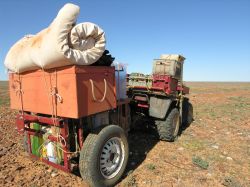
Trip from Station Creek to Andamooka Waterhole, traveling on an ATV and towing a small trailer for the camp, fuel, water and other supplies.
ATV Camping Trip - John McDouall Stuart at Andamooka Waterhole
See relevent extracts from the 1858 journal of John McDouall Stuart
John McDouall Stuart crossed the Australian continent from Adelaide in the south to near Darwin in the north and returned without the loss of any of his men, in contrast to the experience of many of the great, early explorers. On the way, he discovered Andamooka Waterhole.
ATV Ride to Andamooka Waterhole
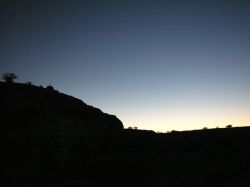
Winter dawn at Andamooka Waterhole, the imposing bluff with it's stone cairn, silloheted against the contrasting tones of the early morning sky.
The trip from Station Creek on Bosworth Station to Andamooka Waterhole on Andamooka Station was about 50 km on station tracks. In a few areas the tracks were good enough to get into top gear and go for it, but mostly it was low gear travel on the ATV pulling a small trailer loaded with camping gear, fuel, water and other supplies.
At times the track disappeared on the rocky ground so that not only was navigation difficult but negotiating the rocks with the trailer was a painstaking task. At other times the track crossed sand dune country with washed out creek crossings to be skirted.
By good fortune the rout passed by Andamooka Station homestead. Pointing out the right track, the manager assured me that the track, marked on the map as passing only a couple of km from Andamooka Waterhole, doesn't exist. However, he gave me good directions on how to get there.
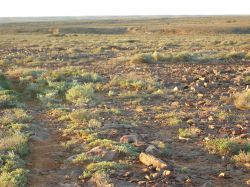
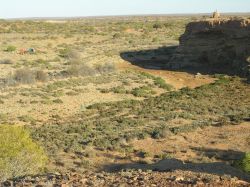
Viewed from a distance, the first sight of Andamooka Waterhole
Camping with John McDouall Stuart
Having used the GPS and map to determine my position and find the right direction when I missed my turn, I arrived at Andamooka Waterhole as the sun was sinking toward the flat horizon of this arid region. A few quick sunset photos and I got too, setting up the tent and scrounging some firewood, before darkness overtook the scene.
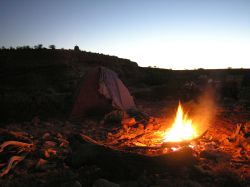
A warm and cheery campfire to light up the camp, cook some tucker and make a cup of billy tea.
Rocks and more rocks. Everywhere, rocks. There was one, little, fairly flat spot without too many rocks, a bit sandy, and about 15 metres from the edge of Andamooka Waterhole, had there been water in it. It was as dry as a bone.
Insignificant camp dwafed by the massive bluff overlooking Andamooka Waterhole.
So, throwing the worst of the rocks and stones aside, I pitched the tent on this small flat, with the ATV facing the tent door so the small light on the front of the bike would throw some welcome light and cheer for the night time jobs at camp.
Breakfast had been after the dawn photography session and before breaking camp. So in the semi-darkness, I could have my second feed for the day. Toast with home made raspberry jam and a cup of black tea went down alright in that situation.
As I looked around in the morning light it was plain that the spot where I camped was the obvious spot, and in fact, about the only spot to camp within a reasonable distance of Andamooka Waterhole.
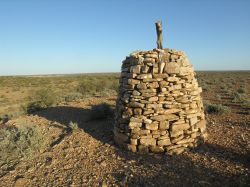
The stone cairn at Andamooka Waterhole, reportedly built by John McDouall Stuart.
Evidence of John McDouall Stuart's Visit
See relevent extracts from the 1858 journal of John McDouall Stuart
On the bluff overlooking Andamooka Waterhole, stands a stone cairn, a bit higher than a man can reach and about a metre and a half across, very neatly built of flat and square rocks with no mortar. Out of the top of the round and domed structure protrudes a pole, possibly of the predominant local myall timber.
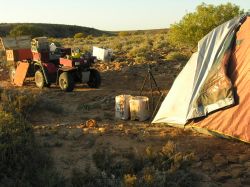
A horse shoe was kicked out of the sand between the tent and the ATV.
While John McDouall Stuart didn't record the building of the cairn in his journal, local belief is that it is his work. He records Andamooka Waterhole as permanent water, in fact he was counting on Andamooka Waterhole as a reliable water supply to fall back on should all else fail in the country ahead.
It seems that after the discovery of Andamooka Waterhole at about midday on Monday 21 June 1858, they they traveled west for several km and surveyed Willaroo Lagoon from an iron stone hill, then returned to Andamooka Waterhole to camp.
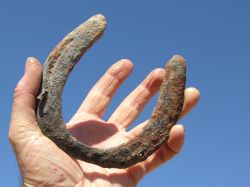
Horse shoe that could be from John McDouall Stuart's own horse.
It's a believable story that they would have built the stone cairn somewhere in this space of time, given the importence that John McDouall Stuart put on it as an emergency back-up.

PORTRAIT OF JOHN MACDOUALL STUART. Adelaide, April 1863. Professor Hall. Photograph.
Given that they'd built a few stone cairns, with three men hooking in it wouldn't take more than a couple of hours to build a marker that stood out starkly on the landscape for a great distance.
John McDouall Stuart's stone cairn at Andamooka Waterhole has stood the test of time, standing out prominently on the bluff after 150 years.
Between the tent and the ATV, I kicked a bump in the sand and unearthed a horse shoe. Could it be that John McDouall Stuart and his men shod the horses in preparation for the next leg of the journey, while resting at Andamooka Waterhole? Could it be that I found one of the discarded horse shoes?
Well, I reckon it's one of the shoes from John McDouall Stuart's own horse, possibly the grey mare, that I found. That's my story, and I'm sticking to it.